Sections
One coast of pale dunes and another of golden sand beneath the volcanoes: in northern Fuerteventura you can change scenery and waves without changing islands. Corralejo and El Cotillo are the two main bases for a trip centred on surfing.
To start with, a school that picks the beach and provides the transfer solves most of the trip. If you already surf, you can arrange accommodation, rentals and getting around separately. The best base depends on how much you want to move around and how you plan to get in the water.
Prices
| Beach access and surfing on your own | Free |
| Accommodation | From €23/night |
| Board rental (optional) | From €10/day |
| Lessons (optional) | From €50/session |
| Surfcamp (optional) | From €299/week |
Getting to the beaches and surfing on your own is free. If you bring your own board and wetsuit, budget accommodation starts at €23 per person per night. Lessons and surfcamps are alternatives for anyone who wants gear, coaching and transfers included.
Other possible costs:
- Getting to Fuerteventura: you can compare flights on Skyscanner or Kiwi. From the airport there are buses connecting to Corralejo and El Cotillo.
- Food: Corralejo and El Cotillo have supermarkets and restaurants. A hostel with a kitchen or a flat lets you plan meals without relying on an accommodation package.
- Transport: many lessons include pick-up and a return to your accommodation. If you already surf, you can choose between buses, a surf taxi or a car depending on the beaches you want to visit.
- Gear: the courses listed include board and wetsuit. When you rent a board separately, check whether the wetsuit is part of the price.
Accommodation
Surfer’s Retreat, in Corralejo, has dorm beds from €23/night, a kitchen and space to store boards. The minimum stay is three nights. In El Cotillo, FreshSurf offers rooms and flats; Homegrown has flats in Corralejo.
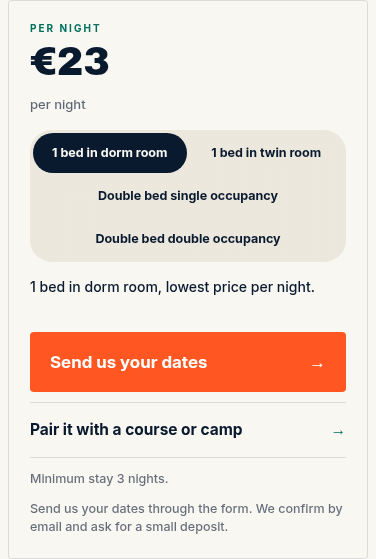
For more comfort, Casa Checa, in El Cotillo costs from €60/night for two, about €30 per person. Homegrown lists flats for one or two people from €315 for seven nights; that is a full-week price. You can also compare hotels and flats in Corralejo or accommodation in El Cotillo.
Board rental (optional)
Homegrown rents a standard board from €10/day or €50/week, with a bag and leash; the longboard starts at €12/day. If you want gear and access to the spot sorted, the surf taxi from Fuerteventura Surf School costs €30 per person per day with board, wetsuit and transfer, no lesson included.
Lessons (optional)
Fuerteventura Surf School starts at €50 per session when you book online, with board, wetsuit, insurance and transfer to the beach. Flag Beach lists a session at €55 and five days at €200, with pick-up and gear. In El Cotillo, FreshSurf offers a session at €60 and five days at €280.

Surfcamp (opcional)
Blueadventure lists €299 for seven nights and five lessons, with shared accommodation, a kitchen, gear and pick-ups for the sessions. For comparison, seven nights at €23 at Surfer’s Retreat plus five days at Flag Beach come to €361. The camp works out about €60 cheaper in that combination; booking separately gives you more freedom to choose your base, room and number of lessons.
Car (optional)
Lessons with pick-up mean you can do without one for the sessions. A car earns its keep if you surf on your own and want to change coasts; compare CICAR and AutoReisen, as well as parking and the distance from your accommodation. For a stay at a single base with a school it may add little.
Videos
Footage from a surf trip along the beaches and reefs of Fuerteventura, with landscapes and sessions in the sea (Fabio Angelini, 2015).
Dan Harmon explains what a surf trip to Fuerteventura is like and shows its landscapes and surf vibe (in English).
Photos


Difficulty
Options run from first lessons to advanced surfing. The key is choosing a beach that suits your level and the conditions on the day.
- For beginners: lessons in whitewater over a sandy bottom, with a school that can move beach. Piedra Playa, in El Cotillo, can work with small waves, but it is not an easy option in every swell.
- Intermediate level: the open beaches let you progress if you can already catch waves independently. El Burro and the area around Grandes Playas offer different options, with both sandy and rocky sections.
- Advanced level: North Shore reefs such as El Hierro. The entries, exits and volcanic seabed require experience; they are not the place to carry on surfing on your own straight after your first lessons.
Alternatives
Surfcamp, single lessons or surfing on your own
A surfcamp combines accommodation, a group and organised sessions. Booking accommodation and lessons separately lets you choose how many days you want to surf. If you are already confident in the water, you can plan the sessions around your own gear, a rented board or a surf taxi.
The map marks the two bases in blue, two beach areas in orange and El Hierro in purple. Select each point to see what it is like and open the location.
Corralejo: more services and flexibility
It fits if you want to compare schools, have plenty of accommodation and eat out without relying on a car. Being close to Grandes Playas does not mean you can walk with your board to any spot: school transfers or a vehicle widen your options a lot.
El Cotillo: a quieter base
It makes sense if the west coast, a smaller village and lessons with a local school appeal to you. Piedra Playa is to the south; the lagoons north of the village are a different landscape and do not replace the surf beach.
What about Lajares?
It is an alternative with a surf scene between the two coasts, especially if you already surf and have a car. Being inland, it is not the easiest base for a first trip without your own transport.
When to go
- Best for balancing surf and price: May, June, September and October. There are options outside the busiest weeks, and schools adapt the sessions to the group’s level.
- More wind and more demand: July and August. The trade winds pick up and some places charge their highest rates; Christmas can be more expensive too.
- For experienced surfers: autumn and winter usually bring more Atlantic swell. If you are just starting out, choose a school that can move the beach and adjust the session to the conditions.
Average air temperature (°C)
Corralejo area · monthly averages 2001–2025
Swell and wind
The viewer lets you compare the two coasts and switch between swell and wind to choose where to go each day.
Pros
- Two different coasts and plenty of beach and volcano scenery without changing destination.
- Schools with gear and transfers let you learn without hiring a car.
- You can choose a surfcamp, a flat with single lessons, or surfing on your own with your own gear.
Cons
- Wind and swell can force you to change beach.
- Accommodation near the sea does not guarantee a surfable spot within walking distance.
- The North Shore reefs require experience; they are not the automatic next step after lessons.
Transport
The Tiadhe network connects the airport with Puerto del Rosario and links on to Corralejo and El Cotillo. The main lines to orient yourself are 3, 6 and 8; the exact plan depends on your base.
With a school: compare the pick-up area before choosing accommodation. The transfer to the lesson beach and the transfer from the airport are separate services.
On your own: the bus connects the villages, but it does not reach every surf access and you still have to carry the board between the stop and the beach. A car pays off more when you want to change coast or explore the North Shore than when you do all your sessions with one school.
Useful FAQs
Which are the cheapest months that still make sense for surfing?
Start by comparing May, June, September and October with July, August and Christmas. The Homegrown flat rates show that seasonal jump. Winter can bring good deals, but bigger waves make it more important to match the sessions to your level.
Does a surfcamp pay off, or is it better to book everything separately?
If you want to learn almost every day, the €299 per week package is competitive against a hostel bed plus five lessons booked separately. If you prefer fewer sessions, a private room or splitting your stay between the two bases, booking separately gives you more room. Always compare the nights, lessons and transfers included.
Is it better to stay in Corralejo or El Cotillo?
Corralejo makes it easier to compare schools, services and connections. El Cotillo fits better if you want a quieter village and have a school in mind, or you prefer the west coast. To start without a car, where the school picks you up matters more than being a few metres from the sea.
Can I manage without a car for the whole trip?
Yes, if you base yourself in a village and take lessons that include pick-up. For surfing on your own at several spots, buses cover the connections between towns, but they are less flexible for following the wind and swell. A middle ground is a surf taxi with gear, if you no longer need lessons.
Do I have to book lessons for the whole week?
No. You can book single sessions or a multi-day course: Fuerteventura Surf School starts at €50 per session online and Flag Beach lists both single lessons and multi-day courses. If you already surf, renting a board or using a surf taxi lets you organise the sessions without paying an instructor.
How much extra does a private room or flat cost?
For two, it can cost only a little more than a shared dorm. Casa Checa, in El Cotillo starts at €60/night for two, about €30 per person, against €23 for a bed at Surfer’s Retreat. Homegrown also lists flats from €315 for seven nights for one or two people.
Useful links
General information
- Official Fuerteventura Tourism website
- Comparing bases: El Cotillo and Corralejo
- Surf reports and island spots
Spots
Schools
Gear rental
Accommodation and surfcamp
- Surfer’s Retreat · Corralejo
- Homegrown · flats
- FreshSurf · rooms and flats
- Blueadventure · surfcamp
- Compare accommodation in Corralejo
- Compare accommodation in El Cotillo