
Sections
In the south you walk between pine trees and turquoise-water coves; in the north you find dunes, reddish rock and a lonelier coast. The Camí de Cavalls lets you discover both Menorcas with the sea as the connecting thread.
You don’t have to walk the whole island. You can link walks and swims from a single base, cover just one coast, or turn its 185 km into a full crossing. You decide the distance of each day.
Prices
| Walking the route and accessing the beaches | Free |
| Wild camping | Free |
| Campsites | From €13/night |
| Transport (public buses) | From €3 per journey |
Walking the Camí de Cavalls is 100% free. There are no private beaches and none that require payment to access.
The cheapest accommodation option is wild camping (using your tent or bivouac to camp on beaches or in woods in the area). It is not officially permitted and you can be fined, especially if you do it in high season, in busy areas and with a tent.
Other possible costs:
- Travel to Menorca: There are cheap flights from many European cities; you can compare on Skyscanner or Kiwi. There are also ferries from mainland Spain (Valencia and Dénia), but they take considerably longer and are not always cheaper.
- Transfers: Public buses run between the main villages on the island from €3. You can also use taxis and companies specialising in airport transfers and similar.
- Food: There are supermarkets and restaurants in most coastal villages. By shopping in supermarkets and picnicking on the beaches and in the woods you come across, you can spend less than €10/day.
- Gear: Nothing special is required, just basic hiking gear (good boots or trail shoes, a large water bottle, etc.). If you are going to wild camp, you will obviously also need your own tent or bivouac bag.
Campsites
Son Bou lists a pitch for two from €24/night: with the tourist tax, about €13 per person. In high summer it can approach €29.
S’Atalaia is another option, from about €14 per person with the tax included, between Ferreries and Cala Galdana.
Both campsites are inland: you don’t step out of your tent straight onto the coastal trail. They work better as bases for combining different walks than for completing the full crossing along the coast.

If you don’t want to carry your tent, the Mini Lodge for two at Son Bou costs from about €20 per person per night, tax included.

Other accommodation
If you prefer an apartment, guesthouse or hotel, you can search on Booking. Son Bou and Cala Galdana make it easy to head out along the south. Maó and Ciutadella offer more connections and services.
Transport
You can use the Menorca bus network to start the circular route or even skip certain stages. Prices are very affordable, from €3 per journey (it varies by line and journey length).

Organised trips
If you prefer an organised trip, Camí de Cavalls 360º and Natour offer packages with accommodation and luggage transport from about €100/day (Natour: €1135 per person for 10 days, 8 stages).
Videos
Short video showcasing some of the most beautiful landscapes of the Camí de Cavalls (3 minutes, music only).
An account of walking the full loop in 7 days (in English, 17 minutes, 2024).
Tips for planning the Camí de Cavalls (in English, 5 minutes, 2024).
Photos


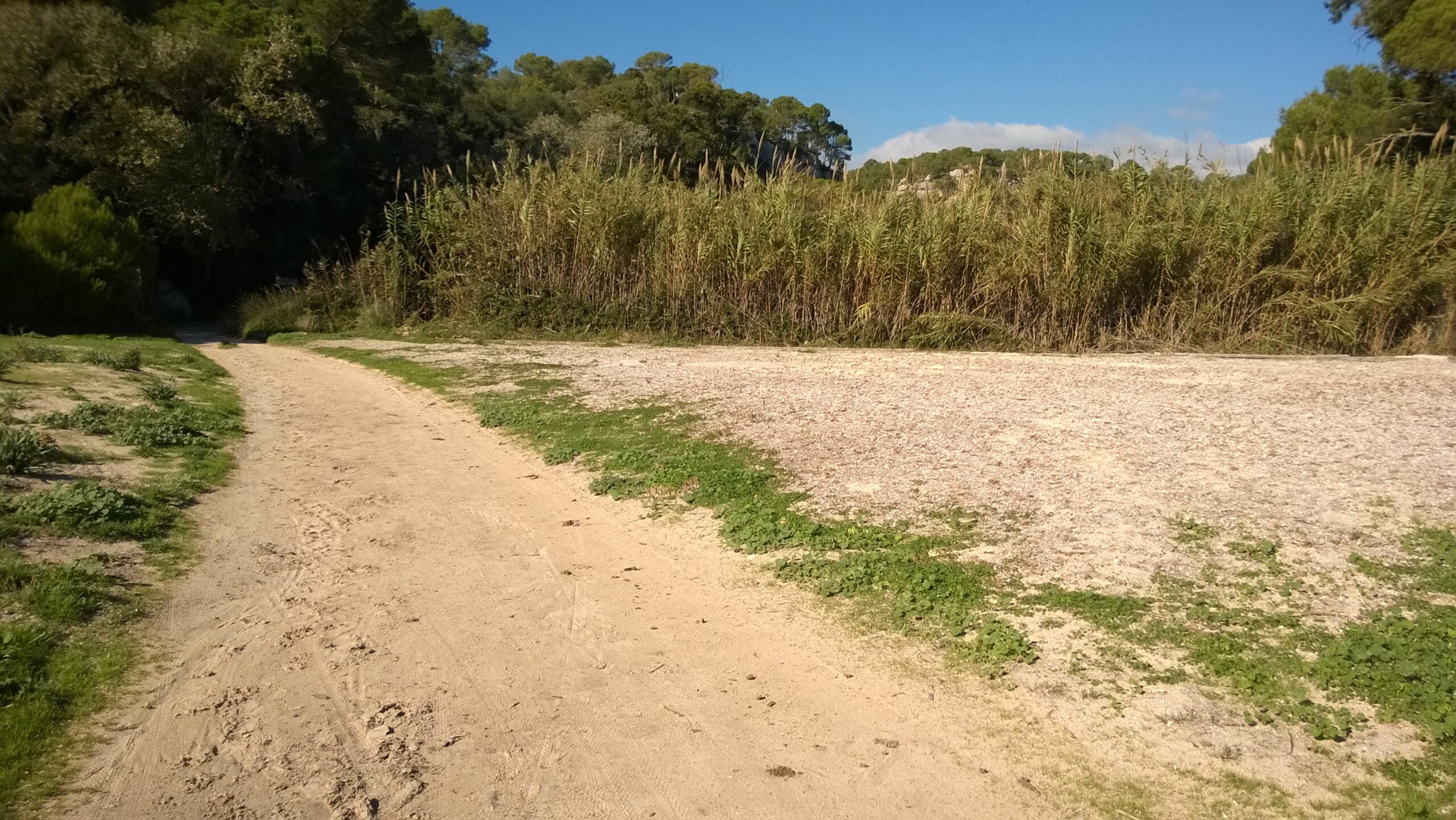
Difficulty
From easy to demanding depending on the section and distance. The trail has no very difficult sections or big elevation gains, but it combines uneven rock, steps, sand and repeated descents to the coves.
- For beginners: Instead of doing the full crossing, you can do day walks along certain sections of the Camí de Cavalls. For example, from Cala Galdana to the nearby coves.
- Intermediate level: Linking several stages between the southern coves is the easiest option for a multi-day crossing.
- Advanced level: The northern sections with fewer services, or the full loop. The difficulty lies in the number of stages, exposure to wind and the gaps between services.
Alternatives
Here we focus on walking routes. It is also possible to do the Camí de Cavalls by bike, which can be less physically demanding but is more technically difficult (paths with rocks, branches, loose sand, etc.)
South: coves, pines and more flexible outings
The Cala Galdana, Macarella, Turqueta and Son Bou area fits if you want to alternate walking and swimming. Son Bou or Cala Galdana let you stay based in one place.
North: a wilder Menorca
Around Pregonda and Binimel·là the landscape changes: reddish earth, dunes and open coast. It is a good alternative to the southern coves, with fewer services in between.
One coast or the whole island
The GR 223 has 185 km and 20 waymarked sections. You can link the ones that appeal most, alternate accommodation or complete the loop. The Komoot collection brings together the route and stage variants: its divisions are useful for exploring the options, they don’t force you to follow the same split of kilometres.

When to go
- Best: May, early June and September. They are a good mix of hiking, swimming and prices outside the summer peak. October allows walking in mild temperatures, but there are fewer connections and open services.
- Not recommended: July and August. The most famous coves and accommodation fill up. The heat makes a long crossing less pleasant. A base with short walks and swims works better than stringing together long days.
- Watch out for the wind. The most frequent wind in Menorca is the tramontana, which usually affects the north coast more. It is worth checking the wind forecast and having an alternative plan (perhaps a route in the south).
Average air temperature (°C)
Menorca · monthly averages 2001–2025
Pros
- Two very different coastal landscapes on a small island.
- Quite flexible. You can enjoy the Camí de Cavalls with short excursions, a partial crossing or the full loop.
- The route can be combined with swims in spectacular coves, some with very few people.
Cons
- The campsites do not form a chain along the route; you have to plan how you will get back to the trail.
- In the north there are long sections with few services and fewer exit options.
- Accommodation and some bus access get complicated in high summer and winter, for different reasons.
Transport
You can arrive by plane at Maó airport or by ferry at the ports of Maó and Ciutadella.
The Menorca transport website brings together operators and connections; TMSA covers the main axis and several access points to the south coast.
Without a car: Staying in one base with good bus connections and doing one-day routes is the simplest option. For linear routes, look for start and finish points with public transport; many coves along the Camí have no bus stop and no road.
With a car: You gain easy access to more points for one-day routes. On a crossing it is usually more practical to combine buses or transfers than to keep a vehicle parked for days.
Useful FAQs
How many days do I need to complete the full loop?
For the 185 km you can plan a trip of one or two weeks, adapting it to your pace and where you want to sleep. There are accounts of doing the loop in seven days and more relaxed options. The twenty waymarked sections don’t force you to walk for twenty days: you can combine or split them to suit your plans.
Which sections should I choose if I only have a few days?
For walking between coves and stopping to swim, the south around Cala Galdana, Macarella and Turqueta is an easy option to combine. Pregonda and Binimel·là offer the reddish, more open coast of the north; Punta Nati and Cala Morell show a different landscape of rock and dry-stone walls. You can choose one area or split your stay between two bases.
Can you do the Camí de Cavalls independently, without a guide?
Yes. The GR 223 is a public waymarked path. The main organising work is fitting together accommodation, access and return journeys: some sections end at coves with no village next to them. Services with a guide, luggage or transfers are conveniences, not a requirement for walking it.
Is it worth going if I am not going to complete the loop?
Yes. The island’s different landscapes and coves are enough for several days without turning it into a crossing. You can choose one base and combine outings of different lengths, or split your stay between the two coasts.
Can I do the crossing without carrying all my luggage?
Yes. Camí de Cavalls 360º and Natour offer solutions with accommodation and luggage transfer, but the price can be considerably higher than if you book cheap accommodation yourself and carry your own backpack.
Can I sleep in my tent at the coves?
Some people do, but it is not officially permitted. The coves are not a network of camping areas and protected areas have restrictions on camping and overnight stays. If you want to avoid possible fines, use campsites or other accommodation.
Is it better to have one base or keep changing accommodation?
One base is convenient for exploring an area without repacking your backpack every morning. Changing accommodation pays off if you want a continuous crossing or want to see both coasts.
Is there water and food at the end of every section?
No. In centres such as Maó, Ciutadella, Fornells, Cala Galdana or Son Bou there are services, but a cove doesn’t mean there is a shop, bar or drinking water. This matters especially in the north and the north-west: when deciding the route and where to sleep, identify the villages where you can restock supplies.
Useful links
General information
- Official Camí de Cavalls website
- Official Caminos Naturales website (detailed info by stage)
- Official Menorca Tourism website (general information about the island)
- Official brochure and map (in English)
- Best sections of the Camí de Cavalls (with photos)
- Account of the Camí de Cavalls in 7 days (trip made in 2025)
- Traveller reviews (Tripadvisor)
Routes
Accommodation
- Camping Son Bou · pitches and equipped accommodation
- Camping S’Atalaia · rates
- Booking (guesthouses, apartments and hotels in Menorca)
Transport
- Menorca bus network
- TMSA (local bus company)